The Aesthetics of Exclusion
The Aesthetics of Exclusion: Why Most Accessible Hotel Rooms Are a Financial Mistake
Marcelo Roisman
6/13/20192 min leer
The Aesthetics of Exclusion: Why Most Accessible Hotel Rooms Are a Financial Mistake
By Marcelo Roisman, Founder of Inclusive Living International
In the global hospitality industry, the accessible guest room often represents a compromise. It is a space created not out of design vision or market opportunity, but out of legal necessity.
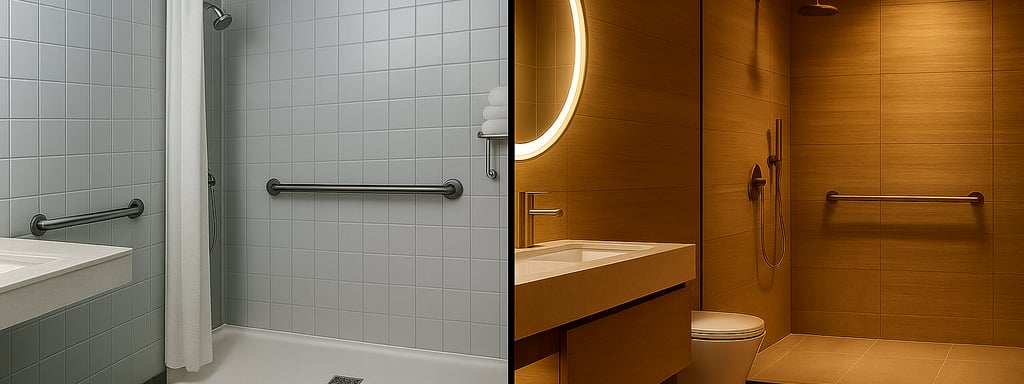
The result is what we call the "Aesthetics of Exclusion": rooms that are typically functional, but visually cold, institutional, and distinctly separate from the rest of the hotel’s luxury offering. They are rooms that guests who don't need the features actively avoid, and rooms that guests who do need them often feel ashamed to occupy. They are costly spaces that perform poorly, achieving the legal minimum while failing the market test.
1. The Financial Flaw in Minimum Compliance
The common approach is a financial mistake for two reasons:
Underutilization: When the design screams "hospital," the room is often left empty or is given away at a discount to guests who do not require its features, creating an immediate loss of revenue compared to standard rooms.
Wasted Marketing Asset: The hotel has paid to build a specialized room, yet that room fails to attract the growing and highly desirable market segment of multi-generational families and travelers with high spending power who value convenience and dignity.
The goal should never be to build a room for "people with disabilities"; the goal should be to build a room for people, designed with universal elegance.
2. Design as the Bridge, Not the Barrier
The Inclusive Living Standard (ILS) methodology treats accessibility not as a checklist, but as a design integration challenge. Our criteria ensure that the essential features necessary for long-term functional longevity are seamlessly integrated:
Discreet Functionality: Grab bars are not industrial add-ons; they are elegant, structurally sound elements that double as towel rails or design features.
Elegant Adaptability: Features like adjustable-height counters or emergency protocols are integrated into the smart room system or the overall architectural aesthetic, so they are available when needed, but invisible when not.
The Unifying Aesthetic: Every room should feel like a luxurious extension of the hotel brand, ensuring that guests of all mobility levels feel welcome and valued, not isolated in a sterile, mandatory space.
3. The ILS: Converting Cost into Competitive Advantage
Our proven standard, rooted in decades of high-volume Home Rehabilitation experience, gives developers and operators the blueprint to create the "Zero-Friction Room."
By integrating our proprietary criteria at the design phase, hotels gain:
Maximized Occupancy: The room is desirable to all guests, eliminating the underutilization penalty.
Market Leadership: The hotel gains a powerful, unique selling proposition in attracting the multi-generational family market.
True Luxury: The ultimate luxury is the comfort of knowing that the space will function perfectly, regardless of the user's needs or the passage of time.
The ILS proves that good design is intrinsically inclusive.
Stop building the aesthetics of exclusion. Start investing in universal elegance that drives value and occupancy.
Contact ILI to learn how our certification transforms accessible design from a legal compromise into a major competitive advantage.
Aqui estamos para ayudarlo
© 2015 All rights reserved.